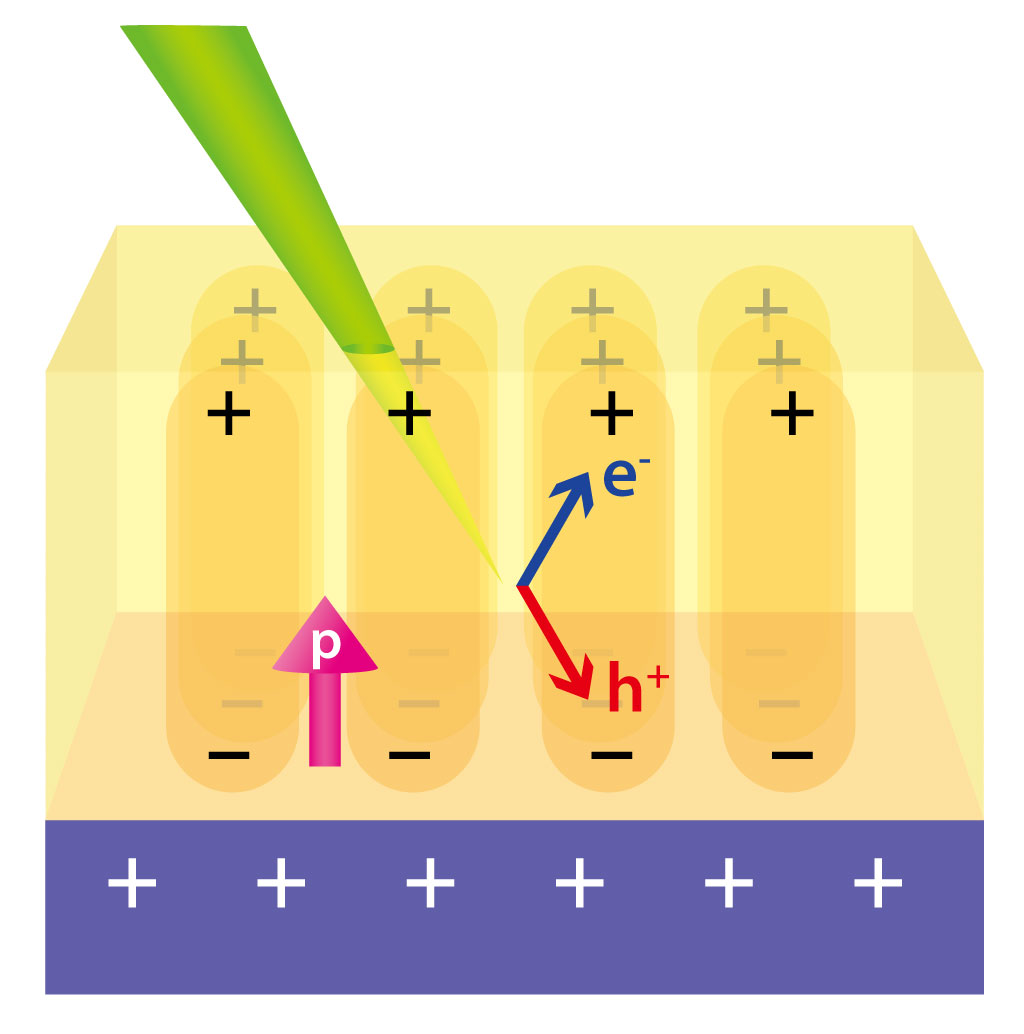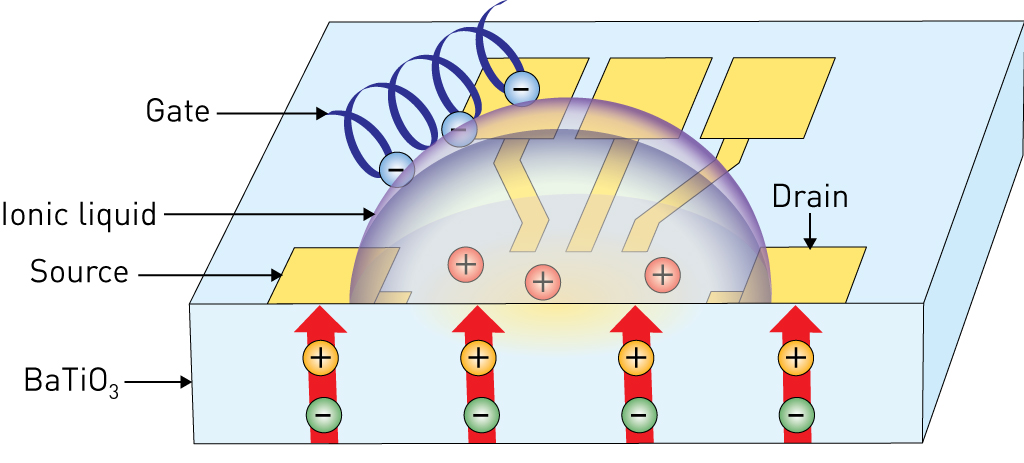
Our team explores dynamic phenomena and nonlinear responses exhibited by strongly correlated electron systems in both bulk and device structures to construct a new scheme for scientific investigation. In particular, we study external-field-driven dynamic phenomena exhibited by sub-micron-scale structures, such as topological spin textures and domain walls, using spectroscopy of dielectric responses and resistance fluctuations from the millihertz to gigahertz region. We also pursue real-space observations and measurements of local physical properties using scanning probe microscopy as a complementary approach. We are aiming to control novel physical properties exhibited by topological structures in condensed matter systems on the basis of knowledge obtained from these methods.
Discovery of a new Hall effect driven by an electric field and a temperature gradient
Chiral materials are promising platforms for quantum-geometry-driven transport, where nonlinear thermoelectric effects beyond simple proportional responses are predicted but have lacked experimental verification. Here, we demonstrate the nonlinear chiral thermoelectric Hall effect, in which a transverse voltage arises from the coexistence of an electric field and a temperature gradient. Using single crystals of the helical semiconductor tellurium, we show that a Hall voltage appears even without a magnetic field, reverses sign with crystal chirality, and agrees with first-principles calculations, establishing experimental evidence of nonlinear thermoelectric effects in chiral materials and suggesting potential applications in heat-flow control and waste-heat energy harvesting.

Schematic illustration of the nonlinear thermoelectric Hall effect driven by an electric field and a temperature gradient (left), and Hall voltages generated in right-handed and left-handed tellurium crystals as a function of the temperature gradient (right). The relationship between the sign of the temperature gradient and that of the Hall voltage is reversed between the two chiralities.
Narrowband voltage signal accompanying the DC-current-driven skyrmion lattice
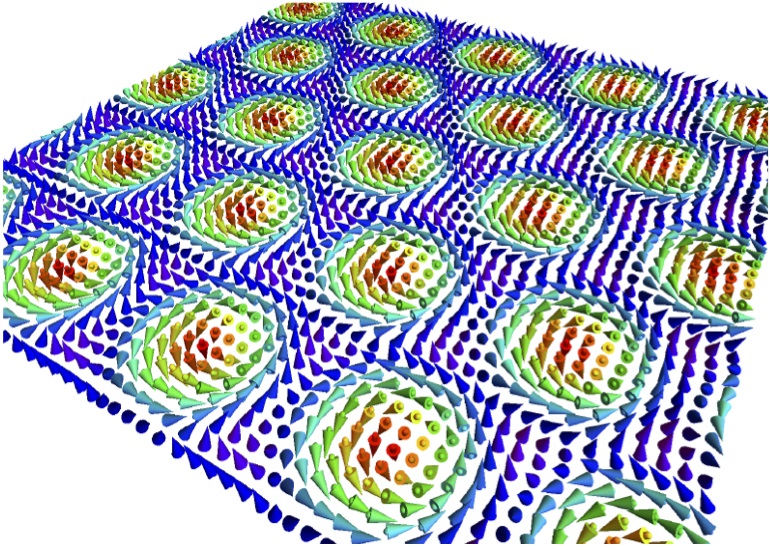
An aggregate of magnetic skyrmions is an emerging exotic fluid that flows under an electric current. From a hydrodynamics point of view, the skyrmion fluid is peculiar in that its steady flow does not necessarily require a closed-loop skyrmion circuit. However, how this peculiarity is involved in the skyrmion steady-flow dynamics remains largely unclear. Here, we show that the skyrmion steady flow dramatically slows down when the influence of system edges is not negligible. In micrometer-sized MnSi, the steady-flow velocity is anomalously slow, 10–6–10–4 m/s, as evidenced by the observation of resistance narrow-band noise of 10–104 Hz. The temperature evolution of this frequency and steady-flow velocity suggests that the steady flow entails skyrmion creation and annihilation at the edges, indicating a vital role of the edges in skyrmion steady flow.
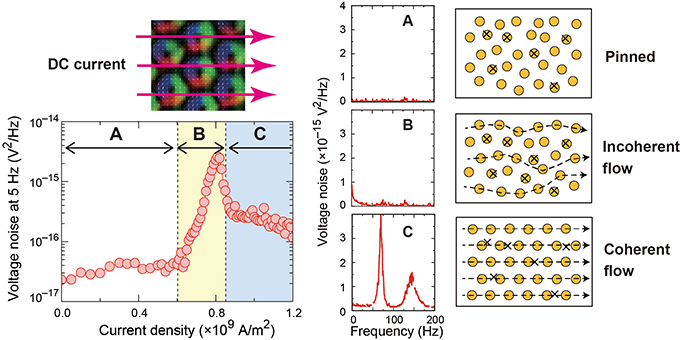
Current density dependence of voltage fluctuations exhibited by a skyrmion lattice under DC current (left), voltage fluctuation spectra in each characteristic skyrmion-lattice dynamic phase (center), and schematics of the assumed dynamic phases (right),
Kinetic approach to superconductivity hidden behind a competing order
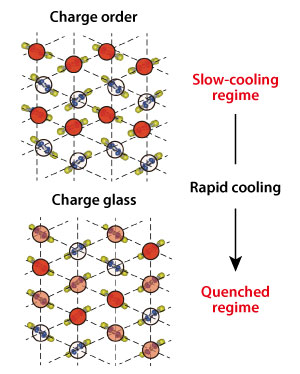
In strongly correlated electron systems, the emergence of superconductivity is often inhibited by the formation of a thermodynamically more stable magnetic/charge order. Nevertheless, by changing thermodynamic parameters, such as the physical/chemical pressure and carrier density, the free-energy balance between the superconductivity and the competing order can be varied, thus enabling the superconductivity to develop as the thermodynamically most stable state. We demonstrate a new kinetic approach to avoiding the competing order and thereby inducing persistent superconductivity. In the transition-metal dichalcogenide IrTe2 as an example, by utilizing current-pulse-based rapid cooling up to ~107 K s‒1, we successfully kinetically avoid a first-order phase transition to a competing charge order and uncover metastable superconductivity hidden behind. The present method also enables non-volatile and reversible switching of the metastable superconductivity with electric pulse applications, a unique advantage of the kinetic approach. Thus, our findings provide a new approach to developing and controlling superconductivity.
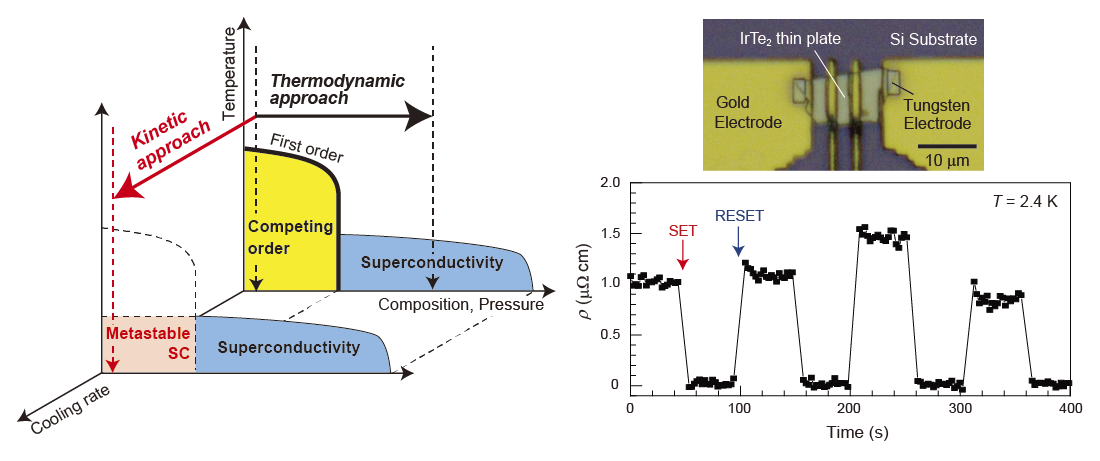
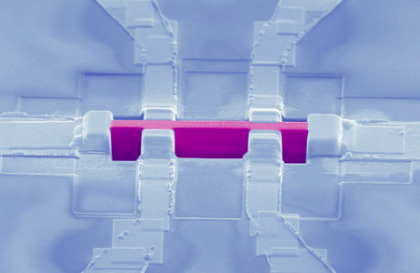
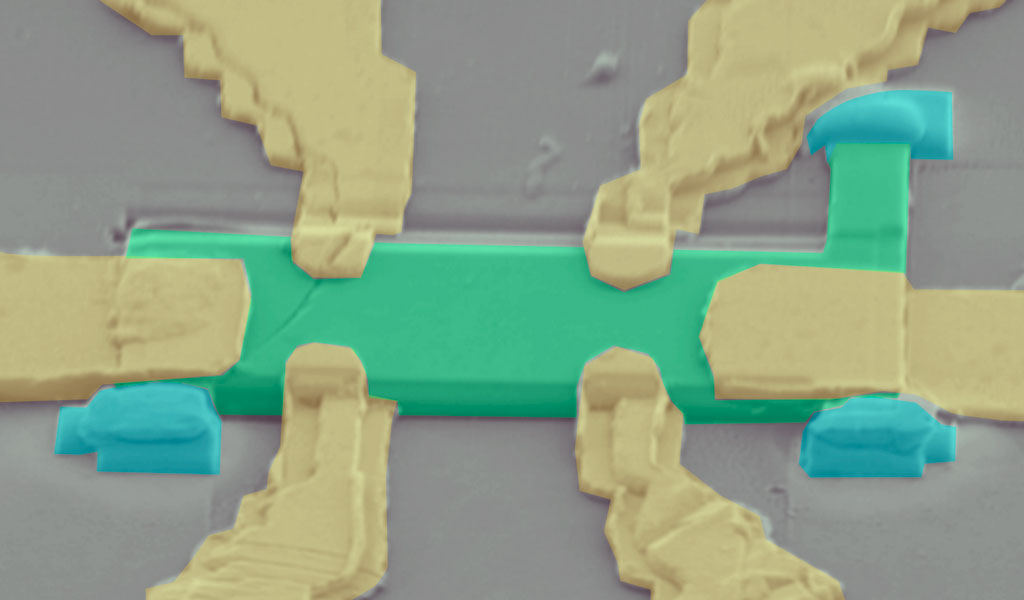
Conceptual phase diagram of superconductivity with ultra-rapid cooling (left), the thin-plate sample used in the experiments (top right) and non-volatile switching between superconducting and non-superconducting states demonstrated by resistivity measurements (bottom right)