Our group aims at obtaining gigantic cross-correlation responses, understanding their mechanisms, and developing new functions in strongly-correlated-electron bulk materials, such as transition-metal oxides. To this end, we try to synthesize a wide range of materials using various methods, including high-pressure techniques, and investigate their physical properties. Specific targets are: (1) exploration of new skyrmion materials; (2) obtaining gigantic magnetoelectric responses in multiferroic materials at high temperatures; (3) exploration of new magnetic materials; (4) exploration of new thermoelectric materials; (5)exploration of new superconductors.
Nonreciprocal charge transport in a room-temperature chiral magnet
Nonlinear electrical responses are attracting much interest in solid-state physics because of their useful functions such as rectification and amplification. Our group focuses on nonreciprocal charge transport and aims to clarify its relationship with chiral spin structures in magnetic materials. In the chiral magnet Co8Zn9Mn3, a conical spin structure emerges, as shown in (a). The nonreciprocal charge transport is observed over a wide temperature range including room temperature. We further identify two distinct nonreciprocal components under different temperature and magnetic-field conditions. One originates from asymmetric spin scattering from thermally fluctuating vector spin chirality affected by the Dzyaloshinskii–Moriya interaction, showing prominent contribution near the transition temperature, as shown in (b). The other arises from an asymmetric electronic band structure formed through exchange coupling between the conical spin structure and conduction electrons, dominating the conically spin-ordered state, as shown in (c).

(a) Schematics of nonreciprocal resistivity and conical spin structure, temperature dependence of nonreciprocal resistivity arising from (b) spin scatterings from vector spin chirality, and (c)asymmetric band dispersions due to conical spin order.
Discovery of new magnet hosting antiskyrmions at room temperature
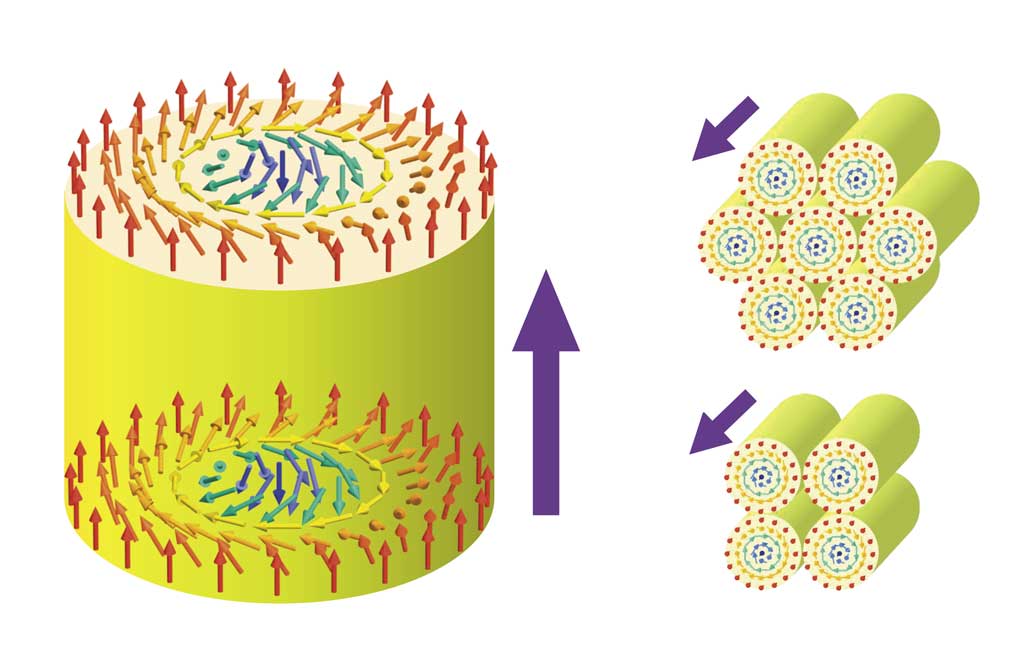
Skyrmion is a nanometric magnetic vortex characterized by an integer topological number, which behaves as a stable particle, and anticipated to be applied to high-performance magnetic memory devices. Recently, a new magnetic vortex, antiskyrmion, with the opposite sign of the topological number has attracted much attention. However, antiskyrmions have thus far been observed only in Heusler compounds with D2d symmetry. This limitation has prevented intensive studies of topological properties of antiskyrmions and their applications. Our group discovered a Pd-doped Schreibersite, Fe1.9Ni0.9Pd0.2P, with S4 symmetry to host antiskyrmions over a wide temperature range including room temperature. It was also found that antiskyrmions and skyrmions are interconverted to each other by changing magnetic fields or sample thickness. Furthermore, sawtooth-like novel magnetic domain patterns with S4 symmetry were observed near the surface of thick crystals.

Schematics of (a) skyrmion, (b)antiskyrmion, and (c) symmetry of the crystal structures hosting antiskyrmions.
Room-temperature skymion and transformation of skymion-lattice in metastable state
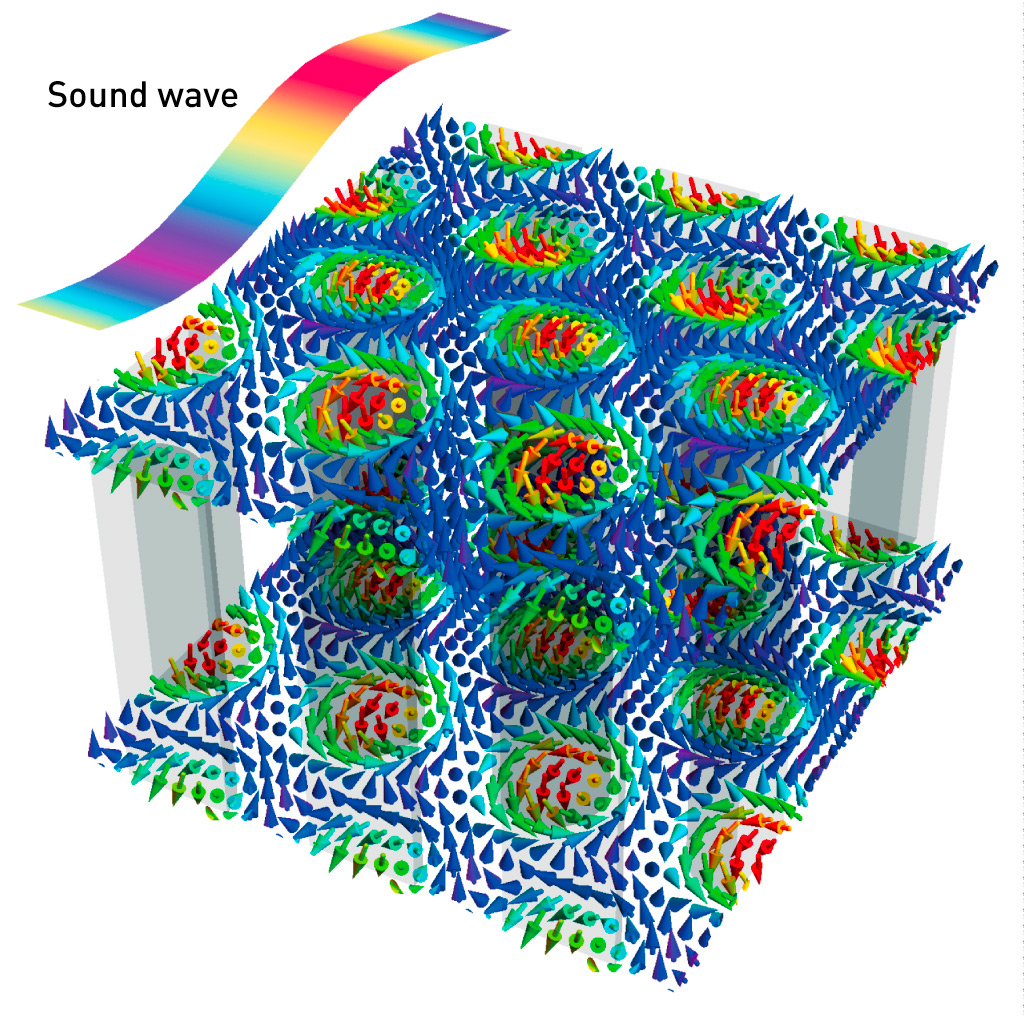
Skyrmion is a magnetic vortex with a nano-meter size which behaves as a topologically protected stable particle, and anticipated to be applied to high-performance magnetic memory devices. However, chiral-skyrmion formation has been observed only below 280 K thus far, and new materials that exhibit skyrmions at higher temperatures have been desired from the viewpoint of applications. Recently, our team discovered a Co-Zn-Mn alloy system with a cubic and chiral, b-Mn type structure that exhibits skyrmion-lattice at and above room temperature. Furthermore, it was found that the skyrmion lattice persists as a metastable state in a very wide range of temperature and magnetic field when cooled down from the thermally equilibrium phase in the applied magnetic field. It was also discovered that the skyrmion lattice undergoes a transformation from a conventional triangular lattice to a novel square lattice during the field-cooling process.

Transformation of skyrmion-latice.